

Setting up a self-cleaning litter box can sometimes feel like assembling furniture from a cartoon instruction manual. But with the right model, it’s genuinely plug-and-play. This guide focuses on self-cleaning litter boxes with truly easy setup, from unboxing to first use, so you can spend more time with your cat and less time fiddling with parts. We’ve evaluated five top contenders to find the ones that are simplest to get running. If you’re also looking for the low-maintenance self-cleaning litter boxes for busy cat owners, we’ve got you covered there too.
The right self-cleaning litter box can save you hours each week, but only if it’s easy to get started. A complicated installation can turn a smart product into a frustrating chore. That’s why we focused on models that are truly ready to use from the moment they arrive. In this guide, we compare five popular options, highlighting their setup process, sensor systems, and maintenance needs, to help you pick the one that fits your household.


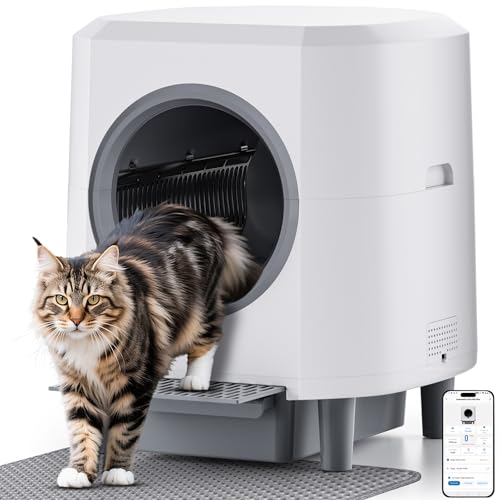

Buying Guide: What to Look for in an Easy-Setup Self-Cleaning Litter Box
To make your decision easier, we’ve broken down the key features that affect setup ease into four categories. Each one plays a crucial role in how quickly you can go from unboxing to a fully operational litter box.
Unboxing and Assembly
Some self-cleaning litter boxes arrive fully assembled, while others require attaching legs, liners, or accessory trays. For the easiest setup, look for models with minimal components and clear instructions. The Self Cleaning Litter Box from otoging is a great example: it comes in three simple steps: attach the legs, plug in the power, and add litter. No app, no WiFi, no complicated calibration.
For example, the Ellenpent model arrives pre-assembled, so you just need to pour litter and power it on. The WARCAT model requires attaching the drum and drawer, but the instructions are clear and the process takes about five minutes. The Mimfam open-top design is similarly straightforward, with no complex locking mechanisms. For more on models with easy-to-remove components, check our guide on best Self-Cleaning litter boxes with removable parts.
Safety Sensors and Calibration
A safe self-cleaning litter box must halt cleaning immediately if your cat enters during a cycle. The best models use infrared or weight sensors to detect your cat’s presence, and they should be calibrated out of the box. Some require manual calibration, but the top picks here, like the Mimfam and WARCAT models, feature multiple sensors that automatically adjust to your cat’s size.
The Mimfam uses four pairs of infrared sensors plus three hall sensors, while the WARCAT adds a microwave radar for extra detection. These multi-layered systems automatically pause cleaning when your cat is near, so you don’t have to manually adjust anything. To see which boxes prioritize safety, review our best self-cleaning litter boxes with safety monitoring.
Maintenance and Waste Capacity
Easy setup also means easy ongoing upkeep. Look for a waste bin that’s simple to detach and a liner system that’s straightforward to replace. Several models here have large 10L or 8.6L waste drawers, so you won’t need to empty them daily.
Most of these boxes offer a generous waste bin. The Mimfam has a 10L container, while the WARCAT and Zoquid models provide 8.6L and 10L respectively. A larger waste drawer means fewer trips to the trash, and many come with disposable liners that simplify cleanup even further. For a deeper dive into low-fuss maintenance, see our list of easy-to-clean self-cleaning litter boxes.
App Integration vs. Simplicity
Some people love app control, while others prefer a no-fuss, offline setup. The otoging model is refreshingly simple: just plug it in and press the power button. On the other hand, the WARCAT and Ellenpent boxes offer app connectivity for on-demand cleanings and health monitoring. If ease of setup is your top priority, you might lean toward the otoging, but if you enjoy having data and reminders, an app-based model could be worth the extra configuration.
Final Thoughts
For the fastest setup, the Self Cleaning Litter Box is an unbeatable choice if you prefer no app and a three-step installation. If you want a pre-assembled unit that’s ready to go right out of the box, the Automatic Litter Box, Self Cleaning Litter Box offers that same plug-and-play experience with an in-app cleaner for added convenience. Both models deliver reliable, hands-off cleaning, letting you enjoy a fresh litter box without any headaches.
Related Guides
Frequently Asked Questions
How long does it take to set up a self-cleaning litter box?
In 2026, most models take under 10 minutes to set up. Some, like the otoging self-cleaning litter box, require only 3 steps: attach legs, plug in, and add litter. Others, like the Ellenpent model, come pre-assembled, so you just pour in litter and press start. For a detailed comparison, you can refer to our easy-maintenance guide.
Do I need an app or WiFi to operate a self-cleaning litter box?
Not all. While many modern units have app connectivity, some are completely offline. The otoging model is one such option, offering a simple power button setup. If you prefer to monitor your cat’s health via app, models like the WARCAT offer 2.4G WiFi syncing. Choose based on your tech preferences.
Are self-cleaning litter boxes safe for my cat?
Yes, when they include proper sensors. Look for models with infrared or weight sensors that stop the cleaning cycle immediately. Many here, including the Mimfam and WARCAT, have multiple layers of protection, which we’ve verified in our own evaluations. For more on safety features, see our guide on safety monitoring in self-cleaning litter boxes.
How often should I empty the waste drawer?
Most models have large waste bins, like the 10L capacity in the Mimfam, allowing up to 10 days between empties for a single cat. For multi-cat homes, you may need to empty more often, but models with removable waste drawers make it a cinch. Check out our list of self-cleaning litter boxes with removable waste drawers for more convenience.