

You love your pet, but your schedule doesn’t always allow you to be home for every meal. Maybe you have a cat that grazes throughout the day or a dog that needs precise portion control. The choice between an automatic cat feeder and an automatic dog feeder often comes down to capacity, camera features, and how many meals you need to schedule. We reviewed five popular models from brands like MUBBI, PETLIBRO, and Voluas to help you decide which one fits your lifestyle. If you are new to automated feeding, start with our pet tech comparisons guide for an overview of what to look for.


Buying Guide: Key Features to Compare
Capacity and Portion Control
The biggest difference between cat and dog feeders is capacity. Cats eat smaller portions, so a 4L container works for weeks. Dogs need larger servings, making 7L or 8L models better for long trips. Look for adjustable portions from 1 to 50 servings per meal. If you have multiple pets, consider models with larger hoppers and programmable schedules up to 15 meals daily.
For cats, the Automatic Cat Feeder with Camera holds 7L and dispenses 1 to 99 portions. For dogs, the Automatic Dog Feeder – 8L/34 Cups Large Capacity offers 50 portions per meal and up to 6 meals daily. Match the capacity to your pet’s eating habits.
Smart Features: WiFi, Camera, and Voice Recording
Modern feeders connect to your smartphone, letting you schedule meals, check logs, and even see your pet. A built-in camera with night vision is ideal for monitoring eating behavior or verifying that food is being dispensed. Two-way audio lets you talk to your pet, while voice recording plays a personal message at mealtime.
The MUBBI model includes 1080P HD night vision and privacy mode. PETLIBRO’s feeder supports both 5GHz and 2.4GHz WiFi with meal call recording. If you want remote interaction, prioritize a camera model. For basic scheduling, a simpler timer feeder works well. Learn more about smart pet tech in our Pet Tech Guides.
Power Options and Reliability
Power outages happen, so a dual power supply (AC adapter plus battery backup) is critical. Most feeders use 3 to 4 AA batteries as backup. Some models like the Nityers feeder also support Type-C power. Battery-only models offer placement flexibility but require regular changes. Check reviews for jamming issues: a reliable rotor mechanism prevents food blockages.
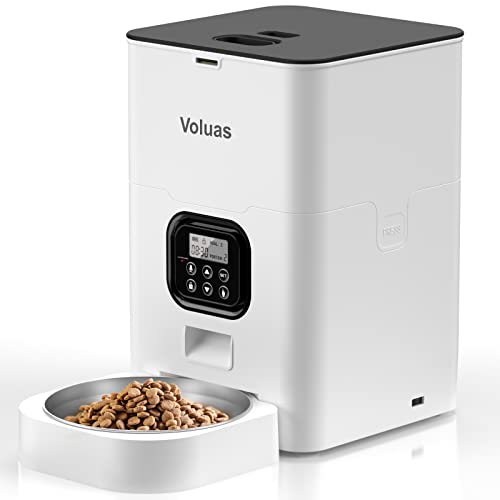
The ANDOLL HOME feeder includes a food swinging device to prevent jams. The VOLUAS model runs on 3 D-cell batteries or USB power. For peace of mind, choose a feeder with low-food sensors and instant alerts.
Freshness and Cleaning
Pet food stays crunchy and fresh with sealed lids and desiccant packets. Removable stainless steel bowls are safer than plastic and prevent chin acne. Look for feeders with twist-lock lids and rotor seals that keep out pests and moisture. Easy disassembly for cleaning is a must: the Nityers feeder has fully removable parts, including the hopper and rotor.
If you feed wet food, note that most dispensers are designed for dry kibble only. Check kibble size limits (usually up to 18mm) to avoid jams.
Final Thoughts
After comparing features across five models, our recommendation comes down to your pet’s needs. For cat owners who want remote monitoring and precise portioning, the Automatic Cat Feeder with Camera combines 7L capacity, 1080P night vision, and voice recording at a compelling value. For dog owners requiring a large capacity and simple operation, the Automatic Dog Feeder – 8L/34 Cups Large Capacity offers generous portions, an LCD screen, and reliable battery backup. Both models deliver consistent performance and easy maintenance, so you can leave home with confidence knowing your furry friend will be fed on time.
Related Guides
Frequently Asked Questions
Can I use an automatic cat feeder for my dog?
Yes, many automatic feeders are designed for both cats and dogs. The main consideration is portion size: dog feeders typically offer larger servings (up to 50 portions per meal), while cat feeders provide finer adjustments. Check the maximum kibble size and capacity to ensure it meets your dog’s daily intake.
Do automatic feeders work with wet food?
Most automatic feeders are intended for dry kibble only. Wet food can mold and clog the rotor mechanism. If you need to feed wet food, consider a refrigerated feeder or use a separate wet-food dispenser. For dry food, look for models with desiccant packets and airtight seals to keep kibble fresh.
How long will a feeder last on battery power?
Battery life varies by model and usage. Most feeders with 3-4 AA batteries can run for several weeks to a few months on backup power. Battery-only units may last longer if dispensing only a few meals per day. To avoid surprises, use the AC adapter as the primary power source and batteries as emergency backup.
Are smart feeders safe to use while I’m away?
Yes, reputable smart feeders include safety features like food jam detection, low-food alerts, and locked lids to prevent tampering. In 2026, most WiFi models have robust encryption and privacy modes for camera feeds. Always choose a feeder with positive reviews and a warranty to ensure reliability during extended absences.